


MANUFACTUREING
Infinite possibilities、
Mino ware and AWASAKA
"Ideas are never-ending and expand infinitely." said a designer.
The more imagination is used, the more ideas and designs will come out. To bring them to life, it all starts with a hand-drawn sketch.
The production of ceramics involves many processes, such as mold making, clay preparation, firing and painting, with specialized artisans in charge of each stage. Moreover, within each process, there are many artisans with different areas of expertise.
AWASAKA approaches design and planning from the unique perspective of a regional trading company, working with kiln masters and artisans to create original products that only we can make.
We see the endless potential in Mino ware, which is said that "there is no distinct characteristic in Mino ware. That is its characteristic".


Types of Molds
A wide range of manufacturing methods are used, from hand-drawn to machine-made.
Pressure casting Drain casting Power-operated lathe Roller machine Slab building Throwing pottery
Pressure casting


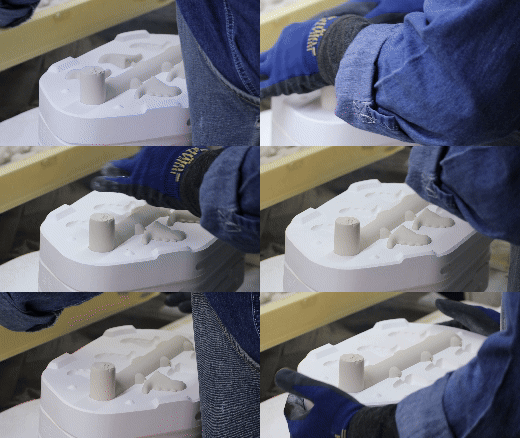
Pressure casting is a method that uses outer and inner moulds ,that is composed of a concave male die and a convex female die, to pour slurry under high pressure for shaping. By combining the moulds, the slurry fills the cavity and hardens before being removed. This technique allows for multiple identical shapes to be efficiently produced simultaneously by connecting the inlet and outlet of the clay and stacking the moulds.
Items made using the way of pressure casting


Drain casting


Drain casting is a forming method where a slurry is poured into a dry plaster mould. It is also known as 'gaba casting.' This technique allows for the creation of complex shapes, often referred to as 'bag forms,' by assembling the plaster moulds like a puzzle.
Common items produced using this method include teapots. As the plaster absorbs moisture from the slurry, it adheres to the mould. Once the desired thickness is achieved, the excess slurry is drained, and the piece inside is dried before being removed from the mould.
Handling the slurry and plaster requires careful consideration of various factors, such as seasonal changes and temperature, making this a skill that demands experience and knowledge.
Items made using the way of drain casting


Pottery-operated lathe


The 'dōryoku rokuro' or 'mizu-gote' is a technique that involves pressing clay into a plaster mold shaped like a bowl. While rotating the mold, water is added using a spatula to create a smooth surface and shape the piece. This method is particularly suitable for shaping items such as rice bowls, teacups, and mugs. The technique requires advanced skill from the craftsman in adjusting the amount of clay and trimming the rim. It is mainly used for small-batch production.
Items made using the way of Pottery-operated lathe.


Roller machine


The "roller machine" is a device that shapes ceramics by inserting clay into a plaster mold shaped like plates and rapidly rotating an inner metal roller to stretch and form the shape of the plates. This method is particularly well-suited for shaping round plates, bowls, and cups. Although an initial investment is required to purchase the molds, multiple plaster molds can be installed in the machine, allowing for the simultaneous production of many ceramics. This results in excellent mass production capabilities and the advantage of lowering unit costs.
Items made using Roller machine


Slab building


Tatara is a technique that uses slab-like clay to create shapes. A long, thin slab known as a tatara board is used to slice the clay into thin, even sheets. By pressing the tatara against a mould, a variety of forms can be created, ranging from simple shapes to more unique designs. This method allows for the efficient production of identical pieces, whilst slight irregularities in the surface and hand-finishing introduce individual differences. These variations contribute a sense of softness and warmth to the work, resulting in pieces that possess their own unique character.
Items made using the way of Slab building

Throwing


It is a method of shaping pottery clay placed on a rotating circular platform powered by electricity with the rotation speed adjusted using a foot pedal. This method has a significant advantage in creating beautiful rotational forms compared to hand building. After creating the base, it is also possible to reshape it into your preferred form. However, the operation requires advanced skills, and creating identical shapes and sizes necessitates a high level of expertise. Additionally, it takes a long time to achieve mastery in the skill of coning up and down after placing the clay on the wheel. This 'throwing' process involves removing fine air bubbles from the clay and ensuring its texture is uniform, repeating the process of pulling the clay up high and then bringing it back down.
Items made using the way of Throwing


Types of decoration for pottery
The difference is whether the paint is applied under or over the glaze.
Decoration is the process of drawing pictures on porcelain. After bisque firing, applying decoration to the unglazed body is called 'underglaze painting.' Painting on the glazed body after the final firing and then re-firing it is known as 'overglaze painting.' Both underglaze and overglaze techniques can also be combined.

Overglaze painting
After applying glaze and firing the body at high temperatures, decoration is painted on top and then fired again at a lower temperature to fix the paint. This technique allows for vibrant expressions, such as gold and red decorations. Since the decoration is applied over the glaze, the surface can be uneven, and the paint may chip off with use over time.

Underglaze painting
This is a technique where decoration is applied to the bisque-fired body, followed by glazing and firing. The colours after firing tend to have a soft quality, and there is a difference in colouration before and after firing. Since the decoration is covered by the glaze, the surface is smooth and resistant to wear and fading.

下絵付け(パッド印刷) 江戸っ子恐竜 良縁竜 大皿

In grazede
While overglaze decoration involves firing paint on top of the glaze, in-glaze decoration is a technique where the paint is immersed within the glaze itself. By applying special paint on the glaze and firing it at a temperature close to that of the final firing, the paint sinks into the melted glass-like surface of the glaze, resulting in vibrant colouration.
Printing Transfers Spray decoration Luster application Sketch
Printing

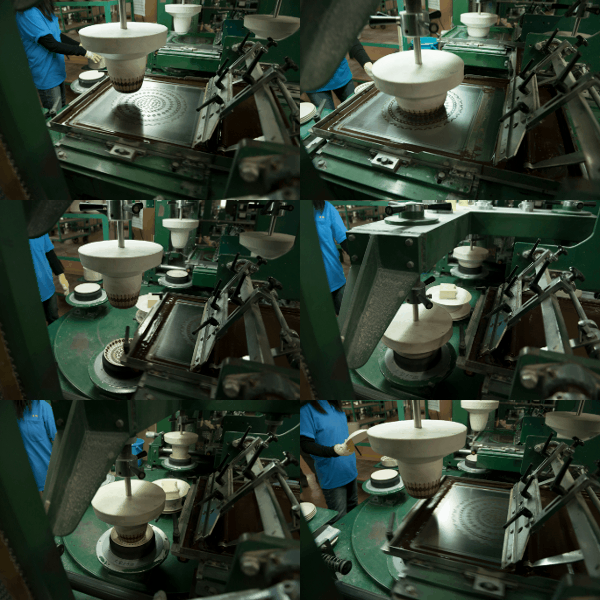


Pad printing" is a decoration technique in which ink is poured into a recessed plate that has the printed design, and a flexible pad made of silicone or similar material is pressed against it to transfer the pattern. This process is applied to bisque-fired pottery. Ink is poured into the recessed plate made from the design original, and a blade is slid across the plate to remove excess ink, leaving ink only in the recessed areas. The silicone pad picks up the underglaze that has flowed into the recesses of the design and prints it onto the pottery. By layering the designs on the printing plate, it is possible to print intricate patterns and onto curved surfaces.
Items made using the way of Printing


Transfers
Transfer paper(Overglaze painting)
Transfer paper(Overglaze painting)


イングレーズは、絵の具を釉薬の中に染み込ませる技法で、焼成後の器に転写し、高温で再焼成することで絵柄が釉薬の中に定着します。摩耗や色落ちに強く、日常使いにも安心な仕上がりです。見た目の美しさと耐久性を両立させた技法です。
Transfer paper(Overglaze painting)


Transfer paper(Overglaze painting)


The technique of applying printed transfer paper to pottery and firing it is called 'transfer decoration.' Transfer sheets consist of a backing, pigments, and a cover coat. They are soaked in water to separate the backing, allowing the design to be applied to the shape of the pottery. Various forms of transfer paper exist, such as transfer stickers and Doh hanshi, which are applied according to the item being decorated. In the case of copperplate transfer, the paper is thoroughly moistened. This allows the underglaze to dissolve, enabling the bisque-fired body to absorb the design, resulting in the transfer. If the paper creases or has air bubbles, the bisque-fired body is unable to absorb the paint, resulting in a poor transfer. Therefore, a higher level of skill is required. This technique allows for any kind of designs and colours.
Items made using the way of Transfers


Doh hanshi(Underglaze painting)


The technique of applying printed transfer paper to pottery and firing it is called 'transfer decoration.' Transfer sheets consist of a backing, pigments, and a cover coat. They are soaked in water to separate the backing, allowing the design to be applied to the shape of the pottery. Various forms of transfer paper exist, such as transfer stickers and Doh hanshi, which are applied according to the item being decorated. In the case of copperplate transfer, the paper is thoroughly moistened. This allows the underglaze to dissolve, enabling the bisque-fired body to absorb the design, resulting in the transfer. If the paper creases or has air bubbles, the bisque-fired body is unable to absorb the paint, resulting in a poor transfer. Therefore, a higher level of skill is required. This technique allows for any kind of designs and colours.
Items made using the way of Transfers


Spray decoration

There are various spraying methods such as full spray for an even application over the entire surface, gradient spray for soft transitions, thread spray for fine lines, and stencil spray using a template. Achieving an even thickness without colour variation by hand requires a high level of skill.
Items made using the way of Spray decoration


Luster application


Luster decoration is a technique that involves applying a rainbow-like coloration on top of ceramics. Luster is a lead glaze containing tin. Patterns are created on the fired white glaze using oxides of copper or silver, which can be applied either by painting or other methods. The piece is then fired in a kiln at low temperatures, around 800 degrees Celsius. The term "luster" in English refers to "shine" or "glistening, As this indicates, the finished product produces a metallic sheen depending on how light strikes it, creating a shimmering iridescence (lustre).
Items made using the way of Luster application

Painting

Sketch

Brush painting

Line drawing

Slip trailing
This technique involves hand-drawing patterns onto the ceramic surface. There are several ways to create drawings in this technique. Depending on the drawing technique, the expressions on the surface can vary. In hand-drawing techniques, there are various styles to explore. The use of brushes is important, as artists choose between thick and thin brushes. Additionally, combining hand painting with brushwork and wheel throwing allows for unique expressions in decoration.
※Click the pictures above to see the details of the handwriting techniques.
Sketch


This refers to drawing patterns directly with a brush. It requires delicate handwork and advanced skills. Since each piece is hand-painted, productivity may be lower. However, each one expresses warmth and a unique character, which contributes to the appeal of the products.
Items made using the way of Sketch


Line drawing


Gold, silver lines or coloured stripes are added for decoration using a brush. The piece is placed on the wheel, and while the wheel spins, a brush is applied directly. There are various patterns of decorative lines, which can be drawn with fine lines of a consistent width or with bold strokes.
Items made using the way of Line drawing

Slip trailing


Ichin refers to tube-shaped or dropper-shaped containers that hold slip or glaze, which is squeezed out. The technique of decorating a piece with slip contained in a tube is called 'Ichin-daki' and is also known as 'tsutsu-daki. When slip is squeezed onto a flat surface of the piece, that area will rise up to form a pattern. The characteristic feature is that the pattern creates texture and a three-dimensional design.
Items made using the way of Slip trailing
